Chapters Are Where the Story Lives
· 5 min read
The same photos, cut differently, make a different book.
Different in kind, not in degree. Take a family’s year, keep every photo that survived the choosing, and only move the chapter breaks. Grouped by trips, it’s a travel record. Grouped by months, it’s a yearbook. Grouped around one person, it’s a portrait. Nothing on the pages changed except where the pauses fall, and the pauses turn out to be most of the story.
That’s what chapters are: the place where a pile of moments picks up a shape. Choosing photos decides what the book holds; chapters decide what it means.
What a chapter does
A book without chapters is a scroll. It might be a beautiful scroll, but it moves at one speed, and somewhere around the fortieth page the reader quietly loses their place. Not their place in the book; their place in the story. Every page-turn asks a small question, where are we now, and chapters are how the book keeps answering it.
A chapter break closes one stretch and promises another. It also hands the reader a place to stop and come back tomorrow, which a scroll never grants; a chaptered book can be read in visits, one era at a time, the way children read the volume they appear in. And on the page, the break earns a small ceremony: an opener with a title, one photo that stands for the whole stretch, maybe a line of text. The pace resets. The reader takes a breath and walks in.
The span picks the unit
The span sets the chapter size, not taste.
Cut a ten-day trip by month and you get one chapter, which is no cut at all. Cut a childhood by day and you get three thousand chapters, which is dust. Between those two absurdities sits a natural unit, and it grows with the territory.
A trip wants days and places. “Tokyo.” “The ryokan.” “Kyoto in the rain.” A single travel day has a full arc: you set out, something went sideways, dinner redeemed it. A day like that carries a chapter without padding. Even arrival, which is mostly airports, is somehow always a story.
A year wants months and seasons. A slow Wednesday can’t hold a chapter, and neither can most ordinary months; a month is usually a texture, not a tale. But “the summer” has a beginning and an end. So does “December,” which in most families is a season of its own.
A childhood wants years, or whole eras with the family’s names on them: “the baby years,” “the first house.” At this width a chapter swallows birthdays whole. An entire party might be two pages inside it, and that’s right, because from this distance the party was two pages.
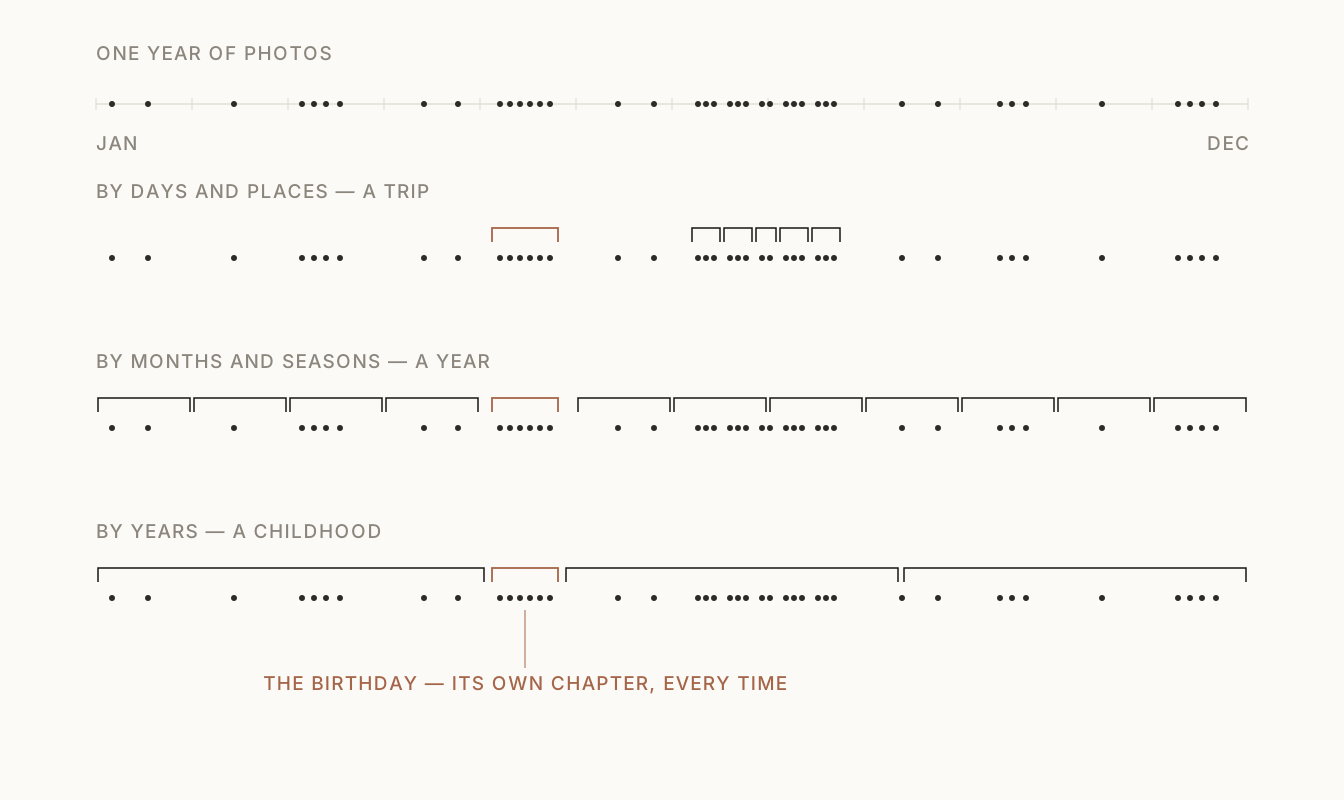
Get the unit right and the book nearly organizes itself. Get it wrong and every decision downstream fights you. Reading the span before you cut is what keeps the rest from fighting you, and it’s the first read Enchanta makes: a weekend book gets chaptered by days, a decade by years, without anyone asking.
Where the breaks already are
Deciding the cuts sounds like one more round of deciding, but they’re mostly already made.
Open your photos for the span you’re working with and look only at the dates. The year isn’t an even ribbon. It’s clumps. Three hundred photos across four days in August. Nothing for two weeks. A burst on a Saturday in October, then the long dribble of ordinary life.
The clumps are events. The quiet stretches between them are chapter breaks, sitting in the timestamps, waiting to be noticed. You rarely have to invent a structure for a year of photos. The year had one, and the camera kept the minutes.
The wedding is not June
Some days refuse to be filed.
In a year cut by months, the wedding technically belongs to June. Nobody experiences it that way. The wedding was not one of the things that happened in June; June was the month that happened to hold the wedding. Readers feel this in their hands. Flip past a wedding tucked inside a monthly chapter and something registers as misfiled, like a birth certificate in the kitchen drawer.
So the big occasions break the calendar. A wedding, a birth, a graduation, the eightieth birthday: each takes a chapter of its own, whatever unit the rest of the book runs on. In a trip book, the day everything went wrong usually deserves one too. The occasion steps out of the stream, takes its room, and hands the story back when it’s done.
Not every occasion clears the bar, and that’s worth saying plainly. A chapter needs enough photos to breathe: an opener, a few spreads, a close. The lovely dinner that produced eight photos isn’t a chapter; it’s a strong spread inside the summer. If an event can’t fill three spreads, fold it in.
The calendar is a guide. The occasion outranks it.
Let the big day be big
Once the chapters exist, the next urge is to even them out: six pages each, fair and square. Resist that too.
A real year is lopsided. Take one family’s year: 3,100 photos. February contributed forty, mostly weeknights and one snow morning. June contributed nine hundred, because of the wedding. Give every month the same two spreads and both months lie. February pads itself with filler while June suffocates, twenty strong photos fighting for every seat.
An honest cut for a thirty-spread yearbook might land like this:
- Winter, five spreads, the snow morning given a full page.
- Spring, four.
- The wedding, seven: the only chapter where crowded pages outnumber quiet ones.
- Summer, nine.
- Autumn into the new year, five.
Thirty spreads. Nobody reading the finished book senses the arithmetic. What they sense is that the book knows what mattered: the wedding got room, February got a nod, and both got the truth.
The same holds on a trip. The two days in Rome can take a third of the book while the driving days share a single spread of windshield and gas-station coffee. Uneven chapters are proportion, and proportion is how a book tells the truth about a year without saying a word.
The shape the family recognizes
Nobody remembers a year as twelve equal months. Memory keeps a few long stretches that blur warmly together, and one or two days that stand alone, out of scale and slightly out of order.
A chaptered book holds the year the same way. The seasons run long and soft. The wedding stands apart, larger than its date. When the family flips through it for the first time and says it feels right, that’s what they’re recognizing. Not the photos; they knew the photos. The shape.
Questions people ask
- How many chapters should a photo book have?
- Four to eight covers most books. A long weekend can carry three; a childhood book might want six wide ones. Past ten, the chapters usually stop being parts of a story and start being folders.
- Does a photo book have to be chronological?
- Usually, yes. Time is the spine readers expect, and fighting it confuses more than it intrigues. But treat chronology as a spine, not a cage. An occasion can step out of the stream and take its own chapter, and a book about one person can be organized by facets of their life instead.
- Do chapters need titles?
- Short ones, yes. Use the name the family already uses: "The rain day," "Grandma's kitchen," "The move." A bare date range is a label, not a title. One honest line tells the reader what the stretch was about.
- Is it OK if some chapters are much longer than others?
- It's better than OK; it's accurate. The wedding deserves five spreads and a quiet February deserves one. Chapters of identical length are usually a sign the calendar made the decisions instead of the story.