How to Turn a Big Trip Into a Printed Travel Book
· 4 min read
The best time to make a travel book is the month after the trip, while you still remember which photos meant something. The mistake almost everyone makes is trying to include the whole trip (every temple, every meal, every viewpoint), which produces 1,200 photos, no shape, and a project that quietly dies. A great travel book does the opposite. It leaves most of the trip out. Below is how to find the roughly seventy images that actually hold the trip and turn them into a book you’ll open for years, instead of a folder you never reopen.
Your trip isn’t a checklist
A camera roll from a big trip is a record of where you went. A travel book is a record of what it felt like to be there, and those are different collections. The record wants completeness. The book wants the moments you’d miss: the light on the second morning, the meal you didn’t photograph well but can’t forget, the person across the table.
The photos are already there. The book never quite happened, not because the trip wasn’t worth it, but because no one turned 1,200 images into a sequence.
The book already exists in your photos. You’re not building it from scratch. You’re finding it.
Why the travel book stalls (and what fixes it)
You get home, you mean to do it, and then the folder just sits. That’s not laziness. It’s that no one is deciding which of the eleven near-identical sunset shots stays, and nothing forces the book to ever be done.
What you’re missing isn’t an app. It’s an editor and a deadline: someone to make the cuts, and a reason the book finishes this month instead of never. Hold that thought; it’s the whole difference between a printed book and a folder named “Japan 2019 (final).”
The one test: “Would you miss it?”
Not “is this a good photo.” A great trip generates hundreds of good photos and that’s exactly the problem. Ask:
Remove this photo. Does the trip get worse?
The postcard shot of the famous landmark that looks like everyone else’s? You probably wouldn’t miss it. The blurry one of your friend laughing on the train? That one leaves a hole. Would you miss it? quietly favors the real over the impressive, which is why it makes better books than “best photos” ever will.
Find, Cut, Finish
Find. Follow the trip’s real thread. Usually that’s the days, in order. But let the story lead, not the map. The point isn’t to prove you saw everything.
Cut. Run Would you miss it? hard, and be ruthless with duplicates: one frame per moment, not the burst of nine. A strong travel book runs roughly 60–100 photos across 40–70 pages. From 1,200, you’re keeping around 5–8%. That sounds brutal until you realize the other 92% is why the book never got made.
Finish. Travel books die half-built more than any other kind, because there’s always “one more pass” to do. Finishing means choosing a version, ordering the proof, and shelving it. The shelf test: would this earn a place on the shelf, or stay a folder? A finished book of 70 photos beats a perfect imaginary one of 400.
A worked example
One three-week trip to Japan: 3,200 photos.
- Remove duplicates, blurred shots, screenshots of maps and menus, and near-identical bursts → ~700.
- One frame per moment → ~180.
- Run Would you miss it? → 74 photos.
- Arranged into 9 chapters: one per city and one for the quiet day that wasn’t on the itinerary → a 48-page book.
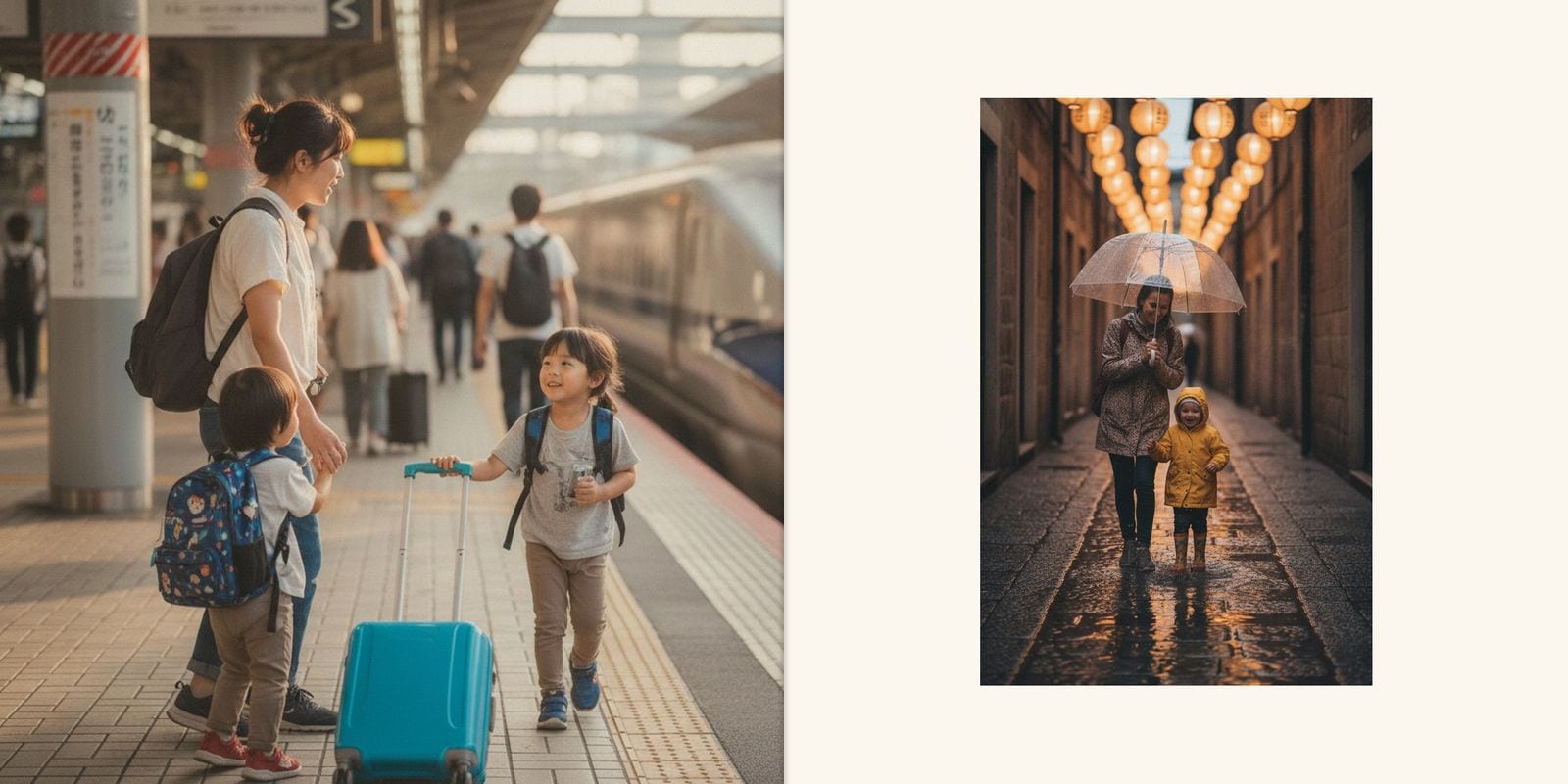
The book skips several famous landmarks. It keeps the small train-station breakfast and the walk in the rain. That’s the trip you actually remember.
Do this this week
While it’s fresh: open the trip, and pull only the photos you’d genuinely miss into one group. Cap it at 90. Don’t sequence or caption yet. You’ll have found the book inside the trip, the hardest and most important move, before the memory fades into “we went to a lot of places.”
Questions people ask
- How many photos should a travel book have?
- Around 60–100 for a 40–70 page book. A trip feels bigger, but the book gets stronger as it gets shorter, up to a point. Restraint is what makes it feel composed rather than dumped.
- Should I include every place we visited?
- No. Completeness is the enemy of a good travel book. Skipping the landmark you photographed exactly like everyone else, in favor of the moment only you have, is what makes the book yours.
- Should photos go in chronological order?
- Usually yes. The days in order is the most natural spine, but let a strong moment break the order if it tells the story better. The sequence serves the feeling, not the calendar.
- When should I make it?
- Within a month or two, while you still remember which photos carry weight. The longer you wait, the more every photo flattens into "a nice picture," and the harder the cuts get.
- Can an app just auto-make my travel book?
- It can auto-assemble one, but automatic selection keeps the impressive and the complete (the landmarks), not the ones you'd miss. The editing is the book. That's the part worth doing with care.