Ten Questions an Editor Asks Every Photo
· 7 min read
A good editor asks every photo the same ten questions.
Not out loud, and not slowly. In a working edit most of them take under a second; a glance settles it and the hand moves on. But when a finished book feels composed instead of accumulated, this is why. Every photo on its pages was asked, ten times, to justify the space it wanted.
Here are the ten. They are not principles. Principles are easy to nod at and easy to ignore. Each of these is a specific cut, the reason an actual photo left an actual book. Together they make a checklist you can run on your own pile this afternoon. They run roughly in order of cost: cheap, brutal cuts first, fine judgments later, once the survivors are few enough to deserve them.
1. Would the book miss it?
Not “is it good?” Good is the wrong bar. You have hundreds of good photos, and they cannot all come. The deciding question is what happens in the photo’s absence: take it out, and does the day still read? Is anyone missing? Did the trip lose its turning point, or just one of its eleven sunsets?
A hole means it stays. No hole means it goes, however pretty it is.
Whole categories go without ceremony: the screenshots, the parking-spot reminders, the fourth photo of the menu. And the survivors are rarely the ones you would predict. Your father asleep under the newspaper makes it. The flawless panorama often does not.
2. Is it the strongest frame of its moment?
Phones shoot in litters. A moment that lasted forty seconds arrives as fourteen files, and an editor works in moments, not files. One moment, one frame.
The birthday candles are the classic case. Fourteen frames across two phones: in six the flame is already out, in three the birthday girl’s eyes are shut, in two an arm crosses the cake, and of the last three, exactly one catches the wish being made. That is the frame. The other thirteen were never really candidates. They were the cost of getting it.
When two frames tie, the tiebreak is faces. Open eyes beat scenery, and the laugh landing beats the laugh starting.
3. Who is it about?
Every book has a cast, and every photo either serves that cast or dilutes it. The plate you photographed because the waiter was standing there. The stranger’s excellent dog. The friend of a friend who ends up anchoring four spreads of your parents’ anniversary. None of these are bad photos. They are cast members from a different production. And the test is protective, not cruel: it is how the birthday child stays on the pages of her own birthday.
“About” is not the same as “contains,” either. In a book about your grandfather, the photo of his workbench, no face anywhere in it, is about him. The group shot where he is a blur at the far edge is not.
The page is not neutral
The first three questions could be asked of a slideshow. The next two exist because the book is paper.
4. Can it print at the size it wants?
A photo arrives wanting a size. The whole family on the terrace wants a full spread; two hands around a coffee cup want a quarter page and some quiet. The question is whether the file can honor the want. A dim restaurant scene that glows on a phone turns to mud on paper. A photo forwarded through three group chats can live small, but ask it to fill a page and it dissolves into fog. Print is honest that way. It cannot add what was never captured.
The mismatch runs the other direction too. A twelve-person group shot pressed into a small slot turns every face into a grain of rice.
5. Can the crop keep every face?
Pages have shapes, and photos are cropped to fit them. Most crops are harmless. The dangerous ones happen at the edges: the uncle standing at the far left of the group is exactly who a square crop deletes, and a trim line has no opinion about whether it passes through sky or through a scalp. On a spread, the fold is an edge too. A face that straddles the gutter gets creased down the middle.
So an editor reads a photo’s edges before granting it a place. If every crop that fits the slot costs somebody a face, change the treatment: the whole photo, matted, a size down. Or change the photo. Nobody closes a finished book admiring a crop, but everybody notices a missing cousin.
These first five are, almost line for line, the checks Enchanta runs when it edits: would the book miss it, one frame per moment, faces kept whole at the size the page asks for. The questions came first. The system exists because photo two hundred of three thousand is where human patience gives out.
The book around the photo
The last five questions assume the photo is good. They ask something harder: does the book have room for what it does?
6. Does the chapter already have this beat?
A chapter is a rhythm of beats: arrival, the set piece, the joke, the rest. Repeat a beat and it dulls. The market chapter already holds three close-ups of fruit stalls; the fourth is genuinely lovely and adds nothing, because “lovely stall” is a note the chapter has already played. The same goes for the third photo of everyone eating and the fifth of the kids in the pool. Beats are easiest to hear at the extremes: a chapter that is all jokes exhausts, and a chapter that is all rest never wakes up.
This is the cut people resist most, because the photo did nothing wrong. True. The chapter just got there first.
7. Is it an establishing shot or a detail?
A photo in a chapter is doing one of two jobs. Establishing shots say where we are: the wide beach, the street seen from the balcony. Details say what it was like: the sandy ankles, the receipt in a language nobody could read, the tomatoes.
A chapter usually needs one of the first kind and a handful of the second. Get the ratio wrong and you can name the failure. All establishing shots and it reads like a property brochure. All details and the reader drifts through beautiful fragments, never sure which city they are in. The fix is usually one trade: swap the third wide shot of the valley for the mud on the boots.
Knowing which job a photo does tells you whether the job is already filled.
8. Does it hold where-and-when?
Some photos carry their own coordinates. Snow on the balcony dates the visit; the cast on her wrist dates the spring. The station sign and the birthday banner simply say it outright. Photos like these anchor the reader with no caption’s help; a book needs a few of them, spaced through the pages, or the whole thing floats.
Most photos float, and floating is fine. A good portrait could be any year, and it hardly matters. But in a tight edit, when two photos are otherwise equal, the one that knows where and when it was taken wins.
9. Does it carry feeling, even if it’s imperfect?
Eight questions have cut. This one saves.
A soft photo of a real laugh outranks a sharp photo of a posed one, and it is not close. The only picture of your great-grandmother holding the baby is dim, tilted, and taken half through someone’s shoulder. It stays, and everyone knows it stays. So does the crooked horizon from the exact moment the boat came in, and the overexposed doorway with the right person standing in it. The craft is in the placing: smaller, matted, beside quiet neighbors, so the softness reads as memory rather than mistake.
You can spot an edit that never bent its rules. Every face is sharp, every horizon level, and somehow nobody you love is quite in it.
10. Can it sit beside its neighbors?
The last question arrives late, when the book is nearly real, and it is the only one aimed at a pair rather than a photo. Nobody reads a page; they open to two. The moment two photos share a spread they start talking, whether you planned the conversation or not.
Some pairs help each other: the wide beach on the left, the sandy ankles on the right; place, then texture. Some pairs fight: two crowded group shots shouting across the gutter, two photos heavy with the same red, a tender portrait facing a plate of clams. Editors try pairings before committing to them, because a photo that is strong alone can be wrong in company. When a strong photo has no good neighbor, it moves. When it still has none, it waits for another book.
A finished book is less a collection of winners than a seating plan.
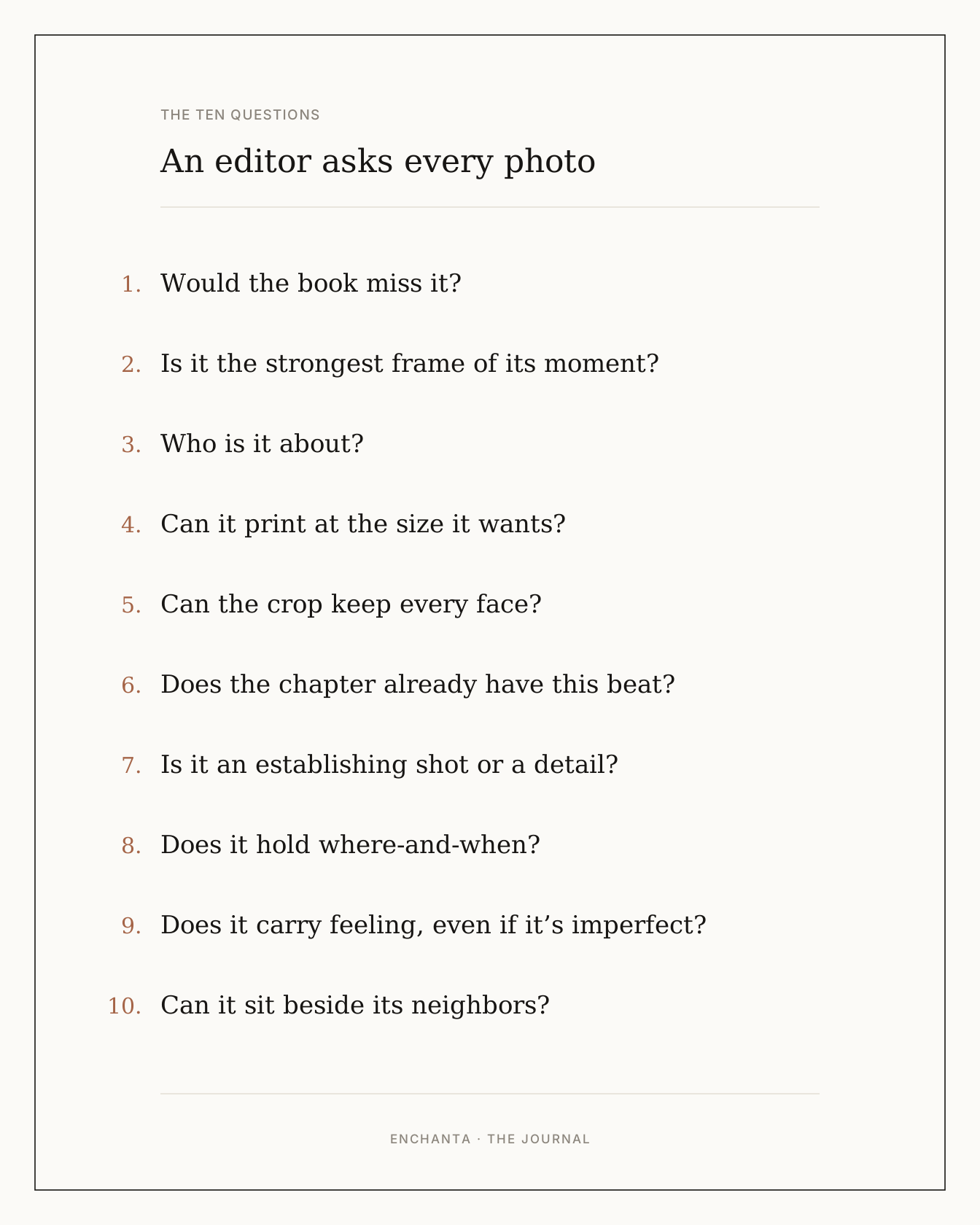
Ten questions is a lot to ask of one photograph. It is. But ask them for a while and you notice they are the same question, asked ten ways: what is this book about? Every keep and every cut answers it a little more precisely, until the book knows what it is.
The photos that pass stop looking chosen at all. They sit on the page as if there had never been another candidate.
People will call it a beautiful book. They won’t feel the ten questions in it, only that they never once had to ask their own.
Questions people ask
- How many photos survive all ten questions?
- Expect roughly one in ten from a single event, and closer to one in thirty from a full year. That sounds brutal until you remember a 40–80 page book only holds around 60–120 photos. The questions are strict because the pages are finite.
- Do the questions work on a phone's camera roll, or only when making a book?
- Mostly, yes. The first two alone will clear most of a camera roll: would you miss it, and is it the strongest frame of its moment. The print and layout questions only start to matter once a real book is on the table.
- Does the order of the ten questions matter?
- Yes. "Would the book miss it?" goes first because it removes the most photos for the least effort, and there is no point checking print quality on a photo the book would not miss. The neighbor question goes last because it can only be answered once the book is nearly built. Cheap cuts early, fine judgments late.
- Why isn't sharpness one of the ten questions?
- Because sharpness is a means, not an end. It shows up inside question four, since a soft photo often cannot print large, and it loses outright to question nine, where a blurry photo of a real laugh beats a sharp photo of a posed one. A perfectly sharp photo of nothing still fails question one.
- What if a photo fails a question but I love it anyway?
- Love wins some of these arguments, and question nine exists precisely so that it can. But the print questions do not negotiate. A photo that cannot survive its size or its crop will disappoint you on paper, no matter how much it means on screen.