One Moment, One Frame
· 6 min read
Nobody takes one photo of anything anymore.
The phone made repetition free. A birthday cake gets nine frames, a sleeping baby gets fourteen, a good sunset gets however many it takes for the freighter to clear the view. This is not carelessness. It is what cameras are for now: the shutter is how we hold still long enough to look.
The book charges for all of it. A printed page has no patience for almost-the-same, and every frame that stays takes a place some other moment wanted. So choosing photos turns out to be one small act repeated a few hundred times: standing in front of a cluster of lookalikes, deciding which one gets to be printed.
It goes faster once you see that the cluster is not one problem. It is five.
Five kinds of repeats
Line up the lookalikes and the pile sorts itself. True duplicates, the same file living twice. Bursts, many frames from a single second. Near-copies, your own retries a few minutes apart. Frames from one moment that carry different beats of it. And the deliberate series, where repeating is the point.
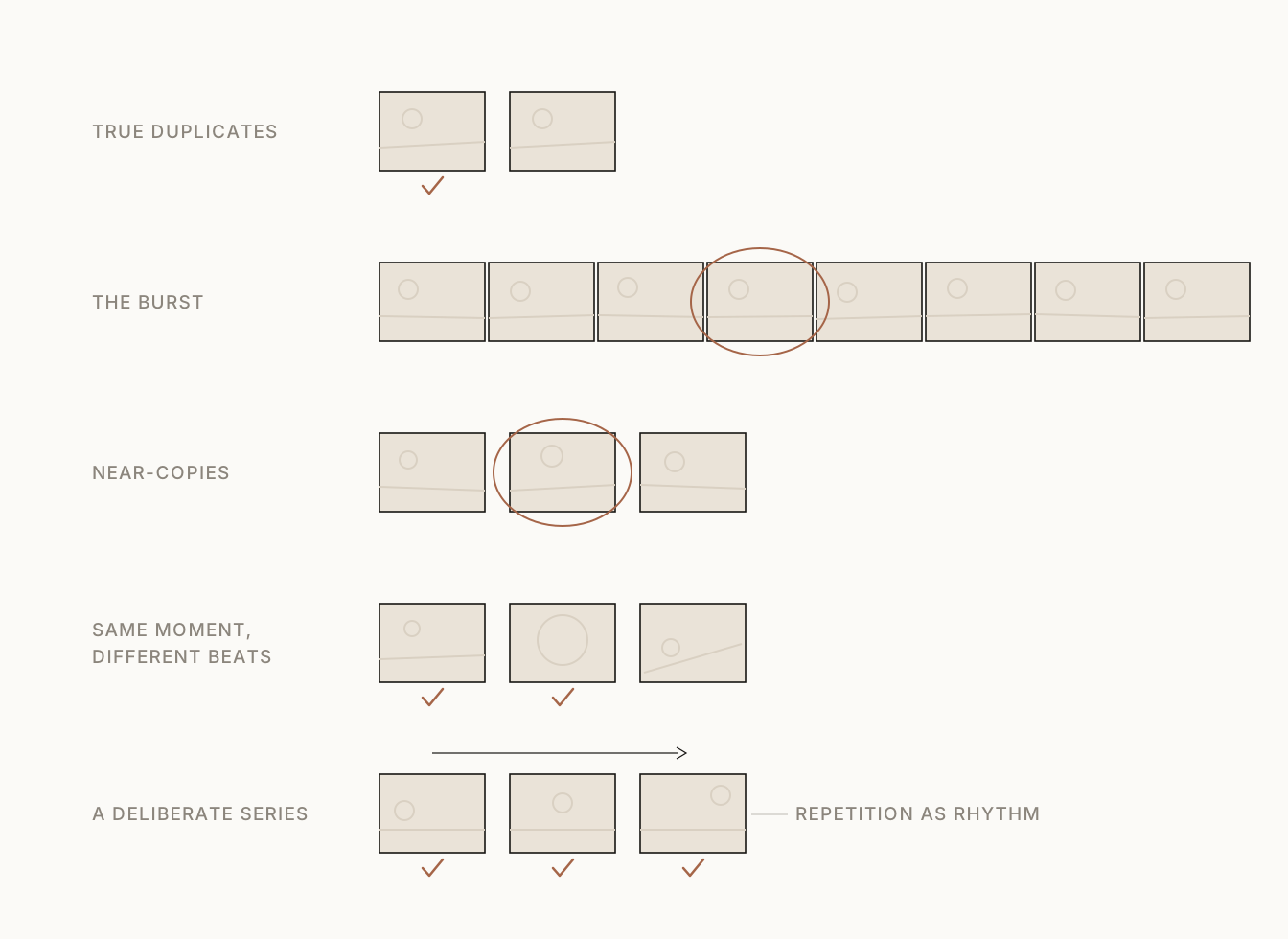
Each kind asks for a different move, and most of the agony in front of similar photos comes from making the wrong one. People hold small funerals for duplicates that deserve none, then flatten a real story because it looked like a burst.
The easy cuts
True duplicates are housekeeping. The same image exported twice, or sent through a chat app and saved again on the way back. Nothing is being judged here and nothing is lost. Delete them on sight.
Bursts only look like a hard choice. Nine frames from inside one second are one photograph spread across nine files, and somewhere in there the moment peaks: the laugh at its fullest, the jump at the top of its arc, the instant when everyone’s eyes are finally open at once.
Finding the peak is quick if you compare instead of contemplate. Side by side, the also-rans concede. Blinks go first, then blur, then the expressions still assembling themselves, and you are left with two finalists. Look at eyes and hands, then at the edges of the frame, where elbows and strangers like to hide. One of the two is fuller. Take it and move on. A burst deserves about ten seconds of your evening.
The hedge
Near-copies are not the camera stuttering; they are you, trying again. A step to the left, a pause for the waiter to clear the background, one more now that the light has come back. Minutes apart, each frame a slightly different opinion about the same subject.
This is where selection stalls, for an honest reason: both frames are good, and both cost you something real. Cutting one feels like declaring the second attempt a waste.
It was a hedge, and the hedge paid off. Because you tried twice, one frame is stronger. Its job ends the moment you learn which.
There is a fast way to learn. Imagine the caption under each frame. If both would share one caption, they are one photograph, and the stronger frame should carry it alone. Stronger rarely means sharper. It means the subject reads at a glance and the clutter stays out of the corners. It is the one you would point at.
And compare side by side. On a phone the two frames live a swipe apart, and a swipe is a memory test, not a comparison: whichever frame is on screen right now tends to look a little better. Put them next to each other and the differences stop hiding. Most pairs settle themselves in five seconds this way. The ones that refuse to settle are usually not near-copies at all.
This is also the cut Enchanta makes most gladly. It notices near-copies and keeps the stronger frame, so nobody has to spend an evening adjudicating between two nearly identical photographs of the same plate of oysters.
Same scene, different beats
The trap runs the other way too. Some frames look like near-copies and are nothing of the kind.
Same table, same candles, same six faces. But in one frame the match is being struck, in the next the girl has her eyes shut over the cake, and in the third the smoke is climbing through the applause. The scene repeats while the story moves. Reduce these to one “best” frame and a small story collapses into a fact: there was a cake.
Here the caption test votes to keep more, because the captions differ. Making the wish is not blowing it out. One frame per beat, not one per scene, and two or three survive, each holding a part the others don’t.
This is the repeat people over-cut. Ruthlessness starts to feel like virtue by the third hour of editing, and the wish gets deleted for resembling the blow. An hour later the book can say the party happened, and cannot say what it felt like. When a moment mattered, check what each frame carries before you thin the cluster. The beats are easy to see once you ask for them, and impossible to recover once only the loudest frame is left.
When repetition is the point
A series is repetition composed on purpose, and it is the only repeat that belongs in a book as repetition.
A laugh that builds across three genuinely different frames. The same kitchen doorway in January and again in June, the child in it taller. What makes a series is change: the laugh moves, the light turns, someone grows. Five reframes of the table setting have no change in them. They are the decision you postponed at dinner, still waiting.
A series also has to be placed like one. Frames together, sized alike, given their own row or their own spread. Scattered through a chapter, the same three frames stop reading as rhythm and start reading as repeats the edit missed. Placement is what tells the reader it was meant.
Nine frames, one circle
Here is the whole craft on one contact sheet.
A grandmother and a five-year-old lean over a birthday cake, and someone’s thumb held the shutter: nine frames in a few seconds. On the screen they are a wall of sameness. Looked at slowly, they are not.
In frames one and two the grandmother is blinking. Frame three is blurred, the girl still leaning in. Frames four through six are the posed stretch (everyone has found the camera and holds a smile for it), and they are the sharpest frames on the sheet, and the emptiest. In frame seven the candles catch and both faces turn down toward the flame. In frame eight the girl watches the flame, and the grandmother watches the girl. Frame nine is the lean back, the moment already loosening.
Seven and eight would share a caption, which makes them one photograph. Eight holds more of it: one face turned to the fire, one face turned to her. Circle eight.
The circled frame is a touch softer than the posed three. It does not matter. Sharpness is a tiebreak, not a verdict, and this was never a tie.
What the second photo costs
The archive should keep all nine frames. Storage forgives everything; that is what it is for.
A page forgives less. The first frame of a moment asks to be looked at. The second teaches the reader to skim, and by the fourth frame of the same cake the reader has quietly concluded that this book repeats itself, and begins turning pages at the speed of that conclusion. Your best spread pays for it three chapters later.
Pages are the other cost. A 24-spread book at three photos per spread holds seventy-two photographs, total. Every lookalike that stays evicts a moment that never gets in at all, so the near-copy is never free. Somewhere a frame that had no twin pays for it: the kitchen in morning light, the ordinary Tuesday that was photographed exactly once.
None of which means shoot less. Take all nine; the eight you cut are the price of the one you circle. Let the camera stutter.
Nine frames, and only one of them was ever the photograph.
Questions people ask
- Should I keep both of two near-copies I love?
- Usually no. Put them side by side and imagine the caption under each: if they would share one caption, they are one photograph, and the stronger frame should carry it alone. Keep both only when each holds something the other lacks: a different look, a different gesture, the next beat of the story.
- How different is different enough to keep two similar photos?
- Different enough that each frame would earn its own caption. A step to the left or a slightly wider framing is not a difference; a changed expression, a new gesture, or the next beat of a small story is. If you can say what the second frame knows that the first does not, keep it.
- How do I pick the best photo from a burst?
- Compare, don't contemplate. Cut blinks and blurs first, then the frames where expressions are still forming, and judge the last two by eyes, hands, and the edges of the frame. The best frame is the one where the moment is at its fullest, and it is not always the sharpest one.
- Should I stop shooting in burst mode?
- No. Bursts are how the peak of a moment gets caught, and the archive can afford them. The discipline belongs to the edit, not the shutter: shoot nine, print one, and let the other eight stay in the roll.
- Do photo sequences belong in a photo book?
- Yes, when the frames genuinely differ, the way a laugh builds or a dive moves from board to water. Place the series deliberately: frames together, sized alike, in one row or across one spread, so it reads as rhythm rather than as repeats the edit missed.